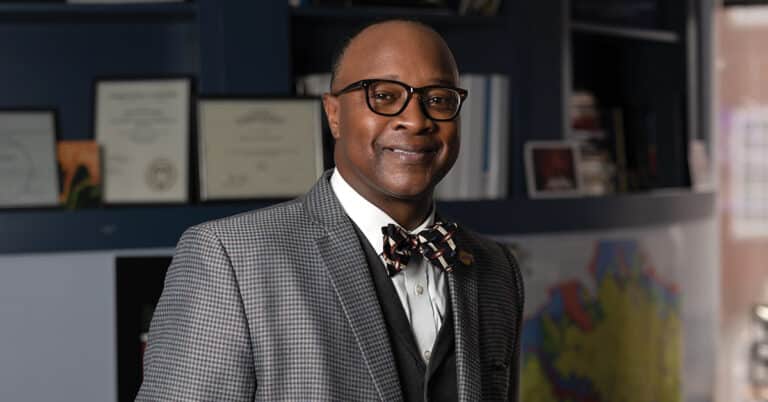



Vice Chancellor for Student Success at the Alabama Community College System
As a first-generation college student, Neil Scott experienced firsthand how meaningful relationships and career preparation can open doors, change lives and strengthen communities. Today, as Vice Chancellor for Student Success at the Alabama Community College System (ACCS), he leads efforts to advocate for Alabama’s students and community colleges while helping institutions deliver the support and services that lead to degree and certificate completion, upward mobility and long-term success. Motivated by seeing students cross the graduation stage with aspirations of serving their communities and supporting their families, Scott remains focused on expanding opportunities for learners across the state. He shares his perspective on student success, educational access and the life-changing impact of community colleges.
What is ACCS, and what role does it serve within the community?
The Alabama Community College System is made up of 24 community and technical colleges and plays a critical role in connecting education, workforce development and economic opportunity across the state. Our colleges serve traditional students, adult learners and employers by providing affordable academic pathways, workforce training and industry-aligned programs that meet regional workforce needs. At its core, ACCS is about creating opportunities and strengthening communities throughout Alabama.
How has your perspective on higher education evolved throughout your career?
Higher education has become much more focused on flexibility, workforce alignment and meeting students where they are. Today’s students are balancing careers, families and financial pressures, while employers are looking for skills-based training and adaptable talent. Community colleges are uniquely positioned to respond quickly to both of those evolving needs. The average age of an Alabama Community College learner is approximately twenty-five, so our students are juggling numerous responsibilities. Community colleges embrace these students and provide the flexibility they need.
If you could change one misconception people have about community colleges, what would it be?
Community college is no longer a backup plan for students seeking higher learning. Today’s community colleges are leaders in workforce development, career preparation and economic
mobility, and students are entering high-demand careers with little or no student debt. For many students, community college is one of the smartest educational decisions they can make.
Some individuals have misconceptions about their own ability to succeed. At an ACCS college, we take students from every stage of life, get them accepted into a program of study, support their educational journey and help them meet their career goals despite the obstacles around them. Everyone is college material at an ACCS institution.
The Alabama Community College System received national recognition from the announcement of a $30 million U.S. Navy-funded investment to modernize maritime workforce training at four ACCS colleges. This partnership highlights the larger role community colleges now play in economic development.
What do you believe makes ACCS unique in the way it supports students?
It has a strong connection to local communities and workforce needs. 96% of our student body comes from the state of Alabama, and 70% of those who complete a program live, work and play in our communities. Our colleges are flexible, accessible and deeply focused on helping students succeed, whether they are pursuing a degree, a certification or a new career path. We serve students at every stage of life and provide pathways that are both affordable and practical.
Are you seeing a cultural shift in how community college education is viewed?
Today’s students are seeing the value of an affordable, career-connected education that leads to workforce credentials and skills-based training. There is also a growing awareness that success doesn’t follow one single pathway. Employers are increasingly looking to our colleges as trusted partners for talent development, upskilling and customized training. Community colleges are the higher education option that provides flexible opportunities that meet workforce demands.
How are Alabama’s community colleges expanding opportunities to respond to changing workforce trends?
Alabama’s community colleges are expanding short-term credentials, work-based learning programs, apprenticeships, dual-enrollment opportunities and workforce training programs that align directly with employer needs. We’re also increasing flexibility through online and hybrid learning models to better serve working adults seeking to enhance their skills and opportunities in rural communities. Through the Alabama Training Network (ATN), ACCS delivers rapid, customized training and technical assistance to help employers strengthen their workforce and stay competitive.
JUST FOR FUN
RECOMMENDED READ:
The Longview by Dr. Roger Parrott or The AI-Driven Leader by Geoff Woods
OUT OF OFFICE:
Needtobreathe, John Mayer, Teddy Swims, Ben Rector and a ton of country music.
DINNER DATE:
It would have to be a dinner date with my wife. It doesn’t matter how many times we go out. I’m always looking forward to the next date.
BY THE NUMBERS
TOTAL NUMBER OF STUDENTS SERVED ANNUALLY ACROSS ACCS:
182,000+ individuals served in the 2024-2025 school year
WORKFORCE TRAINING AND DEVELOPMENT SUPPORT ACROSS THE STATE:
● 129,239 students taking credit-bearing courses
● 37,435 students in not-for-credit workforce programs
● 20,211 enrolled in ACCS Innovation Center Skills for Success Programs
● 40,044 dual enrollment students
● 5,854 trained through the Alabama Training Network (ATN)
Collectively, our ACCS colleges work with over 5,300 companies statewide, supporting training, work-based learning and workforce and skill development.
Each of our colleges has at least one registered apprenticeship program, and there are 84 active apprenticeship programs with more than 254 companies.
Licensed Practical Nursing (LPN) apprenticeships now exist at 13 community colleges, resulting in partnerships with 62 healthcare facilities to help fill the 960 LPN openings in the state each year